Faceted navigation is a powerful feature used on ecommerce and large content websites to help users filter results by attributes such as brand, price, size, color, or category. While it significantly improves user experience, it can also create serious technical SEO problems if implemented incorrectly. Uncontrolled filters often generate thousands or even millions of crawlable URL combinations, leading to crawl budget waste, duplicate content, and index bloat. In this comprehensive guide, you’ll learn how faceted navigation works, when filtered pages should or shouldn’t be indexed, and how to design an SEO-friendly faceted navigation architecture that supports both search engines and users.
Overview
- Why Faceted Navigation Is an SEO Risk
- What Faceted Navigation Means in Technical SEO
- How Faceted Navigation Works on Modern Websites
- Faceted Navigation vs Pagination
- When Faceted Pages Should Be Indexed
- When Faceted Pages Should Not Be Indexed
- Why Faceted Navigation Causes Crawl Budget Waste and Index Bloat
- How Search Engines Crawl Faceted Navigation
- How Faceted Navigation Is Implemented (Parameters, Paths, JavaScript)
- Core Methods to Control Faceted Navigation
- Robots.txt Strategies for Faceted URLs
- Canonical Tag Strategies for Faceted Navigation
- Using Noindex for Filter Pages
- URL Parameter Management for SEO
- Building an SEO-Friendly Faceted Navigation Architecture
- Creating Indexable Faceted Landing Pages
- Faceted Navigation and Keyword Targeting
- Faceted Navigation at Scale (Ecommerce & Enterprise)
- How to Audit and Diagnose Faceted Navigation Issues
- Common Faceted Navigation SEO Mistakes
- Case Study: Fixing a Crawl Explosion
- Faceted Navigation SEO Checklist
- FAQs
Why Faceted Navigation Is an SEO Risk
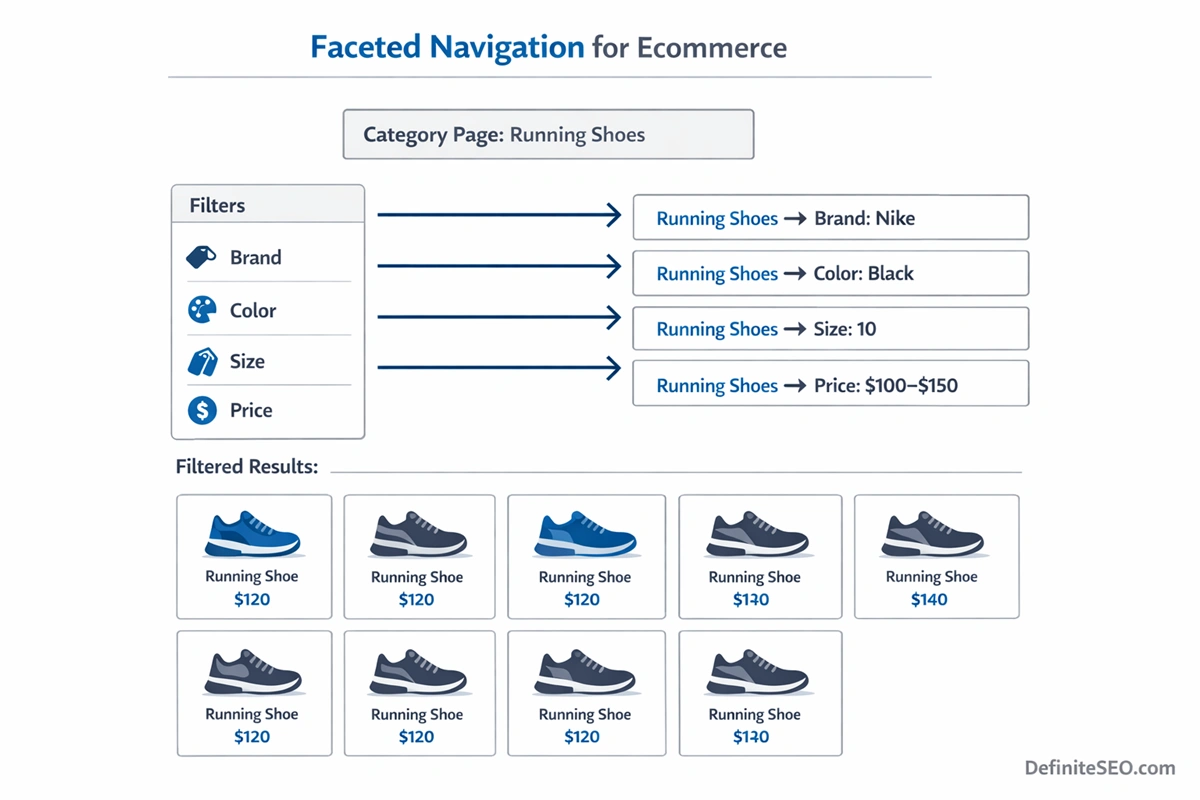
Faceted navigation is one of the most useful user experience features on modern websites, particularly for ecommerce platforms and large content repositories. Visitors expect to narrow down results by attributes such as brand, color, size, price range, or category. Without filters, browsing a catalog with thousands of products would quickly become frustrating.
Yet from a technical SEO perspective, faceted navigation introduces a structural challenge that can quietly undermine an entire website’s search performance.
Each filter selection often generates a unique URL. When multiple filters are combined, the number of possible URLs grows exponentially. A single category page with ten colors, ten brands, five price ranges, and five sizes can theoretically produce thousands of unique URL combinations. Multiply this across hundreds of categories and the site can unintentionally generate millions of crawlable pages.
Search engines such as Google attempt to crawl and understand these URLs. However, many of them represent slight variations of the same product set rather than unique, high-value pages. As a result, search engines waste crawl resources on URLs that should never be indexed. Important pages may get discovered slower, and in extreme cases, the site’s index becomes flooded with low-quality parameter pages.
This phenomenon is often called crawl explosion or index bloat, and it is one of the most common technical SEO problems on large ecommerce websites.
Over the years, I’ve observed that many sites lose substantial organic visibility after introducing aggressive filtering systems without proper crawl controls. Filters improve user experience, but if implemented without a technical SEO strategy, they create a massive expansion of URLs that search engines struggle to manage.
Understanding faceted navigation, how it behaves technically, and when filtered pages should or should not be indexed is essential for building a scalable SEO architecture. The rest of this guide explores these concepts in depth, beginning with the fundamentals.
What Faceted Navigation Means in Technical SEO
In technical SEO, faceted navigation refers to a filtering system that allows users to refine a list of items by selecting multiple attributes, often called facets. Each facet represents a property or characteristic of a product, listing, or piece of content.
For example, consider an online shoe store. A visitor browsing the “running shoes” category may want to narrow results based on attributes such as:
- Brand
- Color
- Size
- Price range
- Gender
- Customer rating
Each of these attributes represents a facet. When a user selects one or more filters, the website dynamically updates the results to show only items matching those criteria.
From a usability perspective, faceted navigation is extremely valuable. It transforms large product catalogs into manageable browsing experiences. Instead of scrolling through hundreds of items, users can quickly narrow their search to a specific subset that matches their needs.
From a search engine’s perspective, however, every filtered combination can generate a unique URL. These URLs typically contain parameters or path variations that reflect the applied filters.
For example, a category page might start with a base URL like:
/running-shoes/
Once a user selects filters such as color and brand, the URL may change to something like:
/running-shoes?color=black&brand=nike
If the user adds additional filters such as size and price, the URL could expand further:
/running-shoes?color=black&brand=nike&size=10&price=100-150
From the perspective of a search engine crawler, each of these URLs appears to represent a different page. Yet in many cases the underlying content overlaps heavily with the main category page or with other filtered versions.
This is where the SEO challenge begins. The goal of technical SEO is to help search engines efficiently discover and prioritize the most valuable pages on a website. Faceted navigation can make that process significantly more complex if the resulting URLs are not carefully controlled.
How Faceted Navigation Works on Modern Websites
Most modern websites implement faceted navigation dynamically. The filters displayed on a category page are typically generated from product attributes stored in a database. When a user selects a filter, the website updates the product results and often modifies the URL to represent that filtered state.
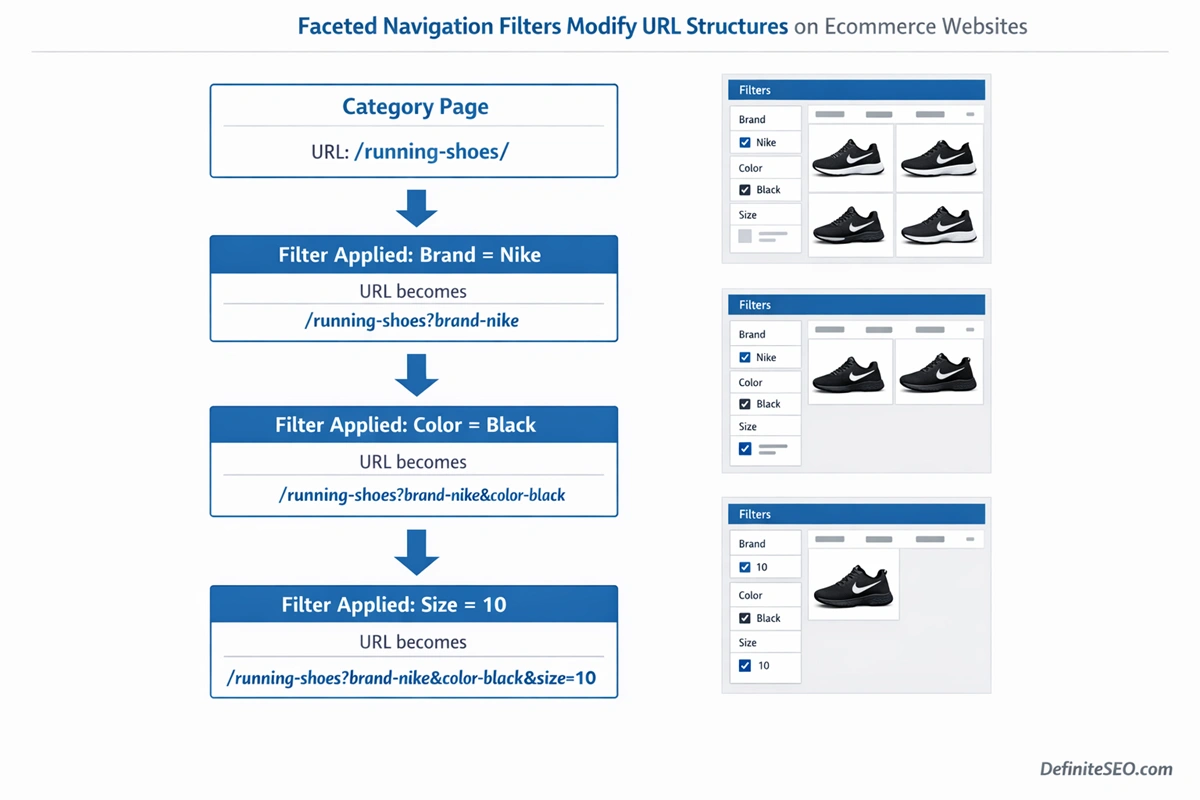
Although the user experience appears simple, the underlying system is capable of producing an enormous number of page variations.
To illustrate this, imagine an ecommerce category with the following facets:
- 12 brands
- 10 colors
- 8 shoe sizes
- 6 price ranges
Even before considering multiple selections, the number of potential filter combinations is already large. When users can combine several filters at once, the number of possible URLs increases dramatically.
For example, these could all represent valid URLs generated by the filtering system:
/running-shoes?brand=nike
/running-shoes?color=black
/running-shoes?size=10
/running-shoes?brand=nike&color=black
/running-shoes?brand=nike&size=10
/running-shoes?brand=nike&color=black&size=10
Each additional filter expands the possible combinations. The result is a combinatorial growth pattern where a single category page can theoretically generate thousands or even millions of unique URLs.
Without safeguards in place, this leads to two major issues.
First, search engines may spend significant time crawling low-value filtered pages rather than focusing on important pages such as category hubs or product pages.
Second, many filtered pages contain very similar content. A page filtered by color may display nearly the same products as a page filtered by brand, creating large amounts of near-duplicate content.
For small websites, this may not create major problems. But for large ecommerce stores with tens of thousands of products, uncontrolled faceted navigation can dramatically increase crawl load and dilute ranking signals across many similar URLs.
Faceted Navigation vs Pagination
Faceted navigation is often confused with pagination because both involve multiple URLs representing different views of a product listing. However, the two systems serve very different purposes and behave differently from an SEO standpoint.
Pagination divides a large list of items into sequential pages. A category page with 300 products might display the first 20 products on page one, the next 20 on page two, and so on. Each page in the sequence has its own URL.
For example:
/running-shoes?page=1
/running-shoes?page=2
/running-shoes?page=3
Pagination organizes content into a predictable linear structure. Search engines can follow the sequence of pages to discover all items in the listing. Because pagination simply segments the same dataset, the number of URLs remains relatively limited.
Faceted navigation, by contrast, changes which items appear based on selected attributes. Instead of moving through a sequential list, the user creates new subsets of the product catalog.
For example:
/running-shoes?brand=nike
/running-shoes?color=black
/running-shoes?size=10
These filtered pages are not part of a simple sequence. They represent entirely different filtered result sets. When multiple facets are combined, the number of potential URLs multiplies rapidly.
This distinction is important because pagination rarely causes crawl explosion when implemented correctly. Faceted navigation, however, can generate thousands of URLs even within a single category page.
When Faceted Pages Should Be Indexed
Despite the risks associated with faceted navigation, not every filtered page should be blocked from search engines. In fact, some faceted pages represent valuable search opportunities and can attract highly targeted organic traffic.
Consider how users search for products online. Instead of searching for a broad category like “running shoes,” many users include attributes in their queries. They might search for:
- black running shoes
- nike running shoes
- waterproof hiking boots
- red women’s sneakers
These searches often correspond directly to common filter combinations on ecommerce websites. When a filtered page aligns with real search demand, allowing it to be indexed can capture long-tail traffic that might otherwise be missed.
For example, a URL like:
/running-shoes/black/
or
/running-shoes?brand=nike
may represent a meaningful product category that deserves its own landing page in search results.
The key is distinguishing between high-value facets and low-value filter combinations. High-value facets typically share several characteristics.
They correspond to common search queries, represent meaningful product groupings, and contain enough items to create a useful landing page. When optimized with appropriate content, titles, and internal linking, these pages can rank for long-tail keyword variations.
Many successful ecommerce sites deliberately create indexable facet landing pages for popular attributes such as brand, color, or style. These pages act as subcategories within the broader product taxonomy, helping the site capture additional search visibility.
However, this strategy requires careful planning. Allowing every possible filter combination to be indexed is rarely a good idea. The challenge lies in identifying which facets deserve dedicated pages and which should remain purely functional filters for users.
When Faceted Pages Should Not Be Indexed
While some filtered pages can serve as valuable landing pages, the majority of faceted URLs should not be indexed by search engines. The reason is simple: most filter combinations do not represent meaningful search demand, nor do they provide unique content that deserves to appear in search results.
Faceted navigation is primarily designed to improve the browsing experience for users who are already on the website. It allows visitors to narrow down results quickly based on attributes such as price, availability, rating, or multiple combinations of product characteristics. However, many of these combinations produce pages that add little informational value beyond what already exists on the main category page.
Consider a scenario where a user filters a category by a narrow price range and an uncommon size. The resulting URL may look like this:
/shoes?size=9&price=83-87
This page might contain only a handful of products and may change frequently as inventory updates. From a search engine’s perspective, indexing such pages rarely benefits users because the content is highly volatile and does not represent a stable, useful category.
Another common example involves sorting filters. Sorting options typically change the order of results rather than the content itself. URLs such as:
/shoes?sort=price-asc
/shoes?sort=popularity
/shoes?sort=rating
do not create new categories; they merely rearrange the same items. Indexing them would produce duplicate or near-duplicate pages competing against each other in search results.
Over time, allowing these URLs to be indexed can lead to thousands of low-value pages appearing in the search index. Many of them will have minimal content differences, thin product listings, or very limited keyword relevance.
Experienced SEO practitioners often apply a simple rule when evaluating faceted URLs: if a filtered page does not represent a real search query or stable category, it should usually remain non-indexable.
This principle helps prevent unnecessary index growth while preserving crawl resources for the pages that truly matter.
Why Faceted Navigation Causes Crawl Budget Waste and Index Bloat
One of the biggest technical SEO risks associated with faceted navigation is its impact on crawl budget and index management.
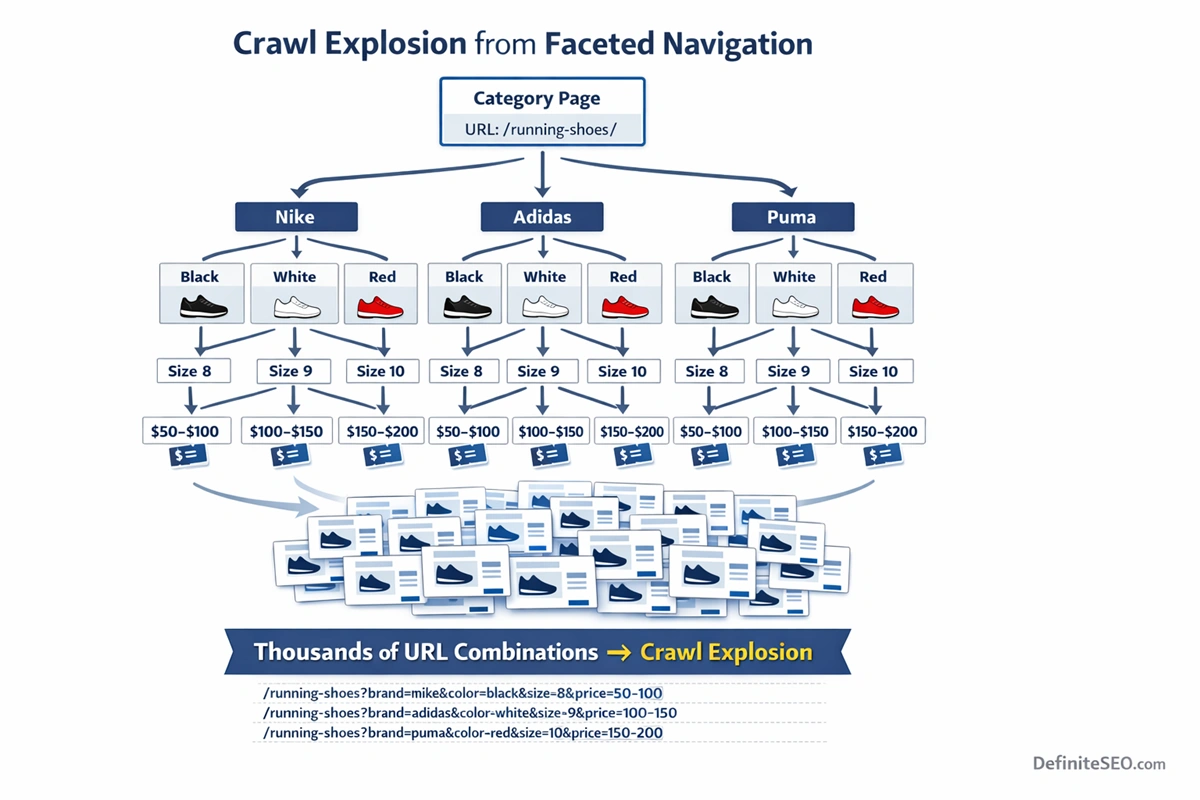
Search engines allocate a limited amount of crawling resources to every website. This resource allocation is commonly referred to as crawl budget. Although the exact limits vary depending on the size and authority of a site, the core principle remains the same: search engines cannot crawl an unlimited number of URLs.
When a site generates large numbers of filter combinations, crawlers may spend significant time exploring these URLs rather than focusing on the pages that actually drive rankings and traffic.
Imagine an ecommerce category with the following facets:
- 12 brands
- 10 colors
- 8 sizes
- 6 price ranges
Even before considering multiple selections, these attributes create dozens of possible filtered views. Once combinations are allowed, the number of possible URLs grows dramatically. A crawler discovering links to these filters can quickly encounter thousands of variations within a single category.
This phenomenon is often referred to as a crawl explosion.
Instead of efficiently discovering important pages such as product listings or category hubs, search engines become trapped exploring countless variations of filtered URLs. Each crawl request consumes resources, and when those resources are spent on low-value pages, more important content may be crawled less frequently.
Another related issue is index bloat. When search engines index too many similar or low-value pages, the overall quality of the site’s index can decline. Duplicate or near-duplicate pages begin to compete with each other, diluting ranking signals that would otherwise consolidate around stronger pages.
For example, if several filtered URLs display nearly identical product lists, search engines may struggle to determine which version should rank. In some cases, none of them perform well because the signals are split across multiple URLs.
You can also review Google’s official documentation on managing faceted navigation to understand how search engines handle large numbers of filter-generated URLs.
I’ve frequently noted in technical audits that uncontrolled faceted navigation can quietly inflate the number of indexable URLs far beyond the actual number of meaningful pages on a website. A store with 20,000 products might unintentionally create millions of filter combinations, overwhelming the site’s crawl efficiency.
How Search Engines Crawl Faceted Navigation
To understand why faceted navigation becomes problematic, it helps to examine how search engines discover and crawl these URLs in the first place.
Search engine crawlers primarily discover new pages through links. Whenever a crawler encounters a link within the HTML of a page, it adds that URL to its crawl queue for future exploration. Faceted navigation systems often generate dozens of filter links within category pages, which makes them highly visible to crawlers.
For example, a product listing page may contain filters for color, size, brand, and price range. Each option within those filters typically appears as a clickable link. To a crawler, these links represent new URLs that might contain unique content.
Once a crawler follows one filter link, it may encounter additional filters on the resulting page. This creates a branching effect where the crawler continuously discovers more combinations. Without restrictions, the crawler may navigate deeper into filter variations such as:
/running-shoes?brand=nike
/running-shoes?brand=nike&color=black
/running-shoes?brand=nike&color=black&size=10
/running-shoes?brand=nike&color=black&size=10&price=100-150
Each step introduces another layer of complexity. Crawlers do not automatically understand which combinations are valuable and which are not. Instead, they rely on signals such as canonical tags, robots directives, and internal linking patterns to determine which URLs deserve priority.
Another factor influencing crawling behavior is the site’s internal linking structure. If faceted URLs appear prominently in navigation menus or sidebars, search engines may treat them as important pages within the site architecture. This can unintentionally signal that these filtered pages deserve to be crawled frequently.
Log file analysis often reveals this behavior clearly. On sites with uncontrolled filters, crawlers may repeatedly access parameter-based URLs while visiting important category pages far less often. This imbalance slows down the discovery of new products and reduces the overall efficiency of the crawling process.
Search engines allocate a limited amount of crawl budget to every website, which determines how many URLs can be crawled within a given timeframe.
How Faceted Navigation Is Implemented (Parameters, Paths, JavaScript)
Faceted navigation can be implemented in several different technical ways, and each approach has different implications for SEO. Although the user interface may appear identical, the underlying URL structure determines how search engines interpret and crawl filtered pages.
The most common implementation relies on URL parameters. In this approach, filters are appended to the base category URL using query strings.
For example:
/laptops?brand=dell
/laptops?brand=dell&ram=16gb
/laptops?brand=dell&ram=16gb&price=1000-1500
Parameter-based filtering is widely used because it is simple to implement and integrates easily with database queries. However, it can also create a large number of crawlable URLs if not managed carefully.
Another implementation method involves path-based filtering, where filters appear as part of the URL path rather than as parameters.
For example:
/laptops/dell/
/laptops/dell/16gb-ram/
/laptops/dell/16gb-ram/price-1000-1500/
Path-based structures often appear more SEO-friendly because they resemble traditional category hierarchies. Many ecommerce platforms use this method when creating indexable landing pages for important filter combinations.
However, even path-based systems can generate excessive URLs if multiple facets are allowed to combine freely.
A third implementation method uses JavaScript or AJAX-based filtering. In this model, filters update the product list dynamically without generating new crawlable URLs. The page content changes within the browser while the underlying URL may remain unchanged.
From an SEO perspective, JavaScript filtering can reduce crawl complexity because fewer URLs are created. However, it introduces its own technical considerations related to rendering and indexing. If not implemented carefully, search engines may struggle to access the filtered content or understand how the navigation works.
Core Methods to Control Faceted Navigation
Because faceted navigation can produce thousands or even millions of URLs, technical SEO strategies must include mechanisms to control how these pages are crawled and indexed.
Several core methods are commonly used to manage this complexity. Each method sends signals to search engines about how they should treat filtered URLs.
One widely used approach involves robots.txt directives, which can prevent search engines from crawling specific parameter patterns. By blocking certain filters at the crawler level, websites can reduce unnecessary crawl activity before it begins.
Another important method involves canonical tags. A canonical tag tells search engines which version of a page should be treated as the primary source of content. When multiple filtered URLs contain similar product listings, canonical tags can consolidate ranking signals to a preferred page, often the main category page.
The noindex directive provides another layer of control. Pages marked as noindex remain accessible to crawlers but are excluded from the search index. This allows search engines to follow links within the page while ensuring that the filtered URL itself does not appear in search results.
Robots.txt Strategies for Faceted URLs
One of the earliest lines of defense against uncontrolled faceted navigation is the robots.txt file. This file allows website owners to instruct search engine crawlers which parts of a site should not be accessed. When used carefully, robots.txt can significantly reduce unnecessary crawling of filter-based URLs.
Faceted navigation systems frequently generate URLs containing query parameters that represent filters, sorting options, or session data. Search engines may attempt to crawl these URLs if they appear in internal links. By blocking specific parameter patterns in robots.txt, a website can prevent crawlers from wasting resources on pages that do not need to be explored.
A typical robots.txt rule targeting parameter-based filters might look like this:
User-agent: *
Disallow: /*?price=
Disallow: /*?sort=
Disallow: /*?availability=
In this example, the crawler is instructed not to access URLs that contain price, sorting, or availability parameters. Since these filters rarely represent meaningful landing pages, blocking them can help reduce crawl noise.
However, robots.txt must be used carefully. Blocking a URL in robots.txt prevents search engines from crawling the page, but it does not automatically prevent indexing if the URL is discovered through external links or internal references. Because the crawler cannot access the page, it also cannot see directives such as canonical tags or noindex meta tags.
For this reason, robots.txt is best used to block obviously low-value filter parameters, such as sorting or pagination variations that do not provide unique content.
During technical SEO audits, I often encounter websites where robots.txt is used too aggressively. Entire filter sections may be blocked without considering whether some facets could serve as valuable landing pages. A balanced approach works best: block the parameters that create crawl traps while leaving room for strategic, indexable facets.
Canonical Tag Strategies for Faceted Navigation
Canonical tags play a crucial role in managing duplicate and near-duplicate pages generated by faceted navigation. While robots.txt controls crawling behavior, canonical tags help search engines understand which version of a page should be treated as the authoritative source.
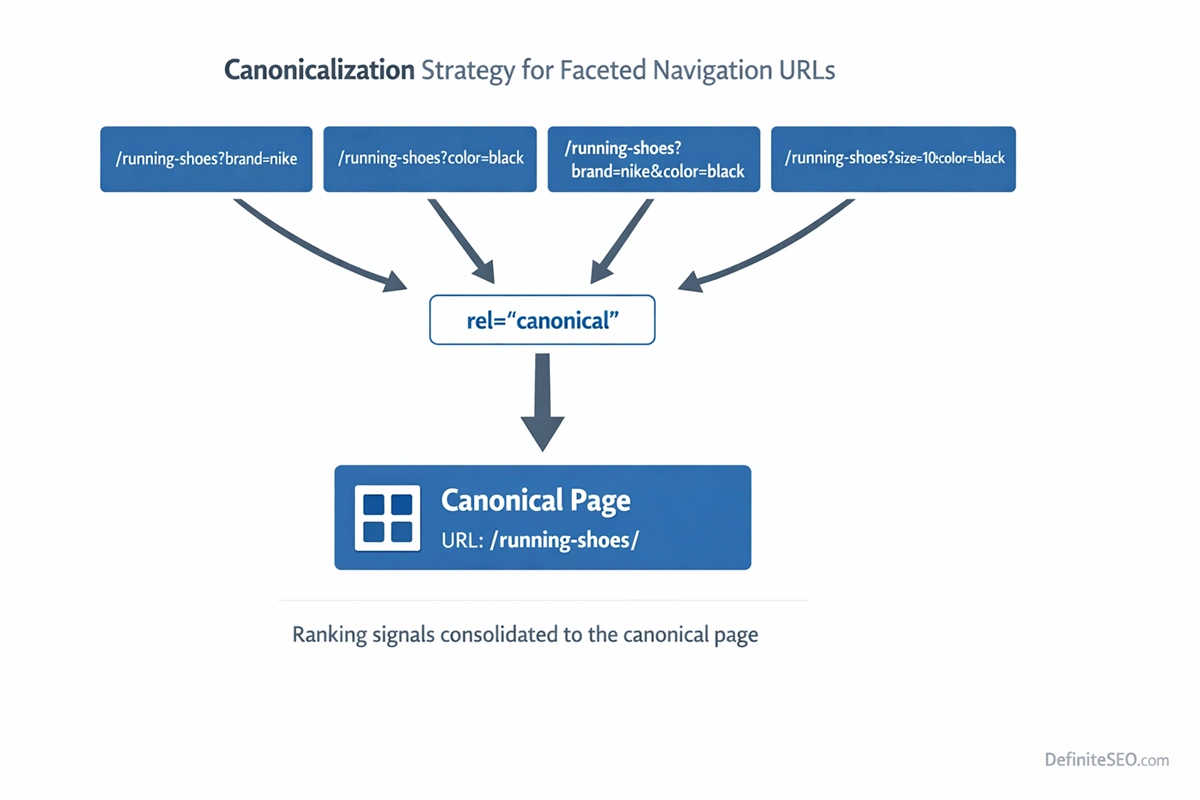
A canonical tag is placed within the HTML of a page and points to the preferred URL for that content. When search engines encounter multiple URLs with similar content, they use the canonical tag as a signal to consolidate ranking signals toward the specified page.
For example, consider a category page that can be filtered by brand or color. The following filtered URLs may all display similar sets of products:
/running-shoes?brand=nike
/running-shoes?color=black
/running-shoes?brand=nike&color=black
If these pages are not intended to rank independently, they can include a canonical tag pointing back to the main category page:
<link rel="canonical" href="https://example.com/running-shoes/">
This approach tells search engines that the base category page represents the primary version of the content. As a result, ranking signals from filtered variations are consolidated rather than split across multiple URLs.
Canonicalization becomes particularly important when faceted navigation produces URLs with different parameter orders. For example:
/running-shoes?brand=nike&color=black
/running-shoes?color=black&brand=nike
Although these URLs represent the same filter combination, search engines may initially treat them as separate pages. Canonical tags help resolve this ambiguity by directing both versions toward a single preferred URL.
At the same time, canonical tags can support selective indexation of valuable facet pages. If certain filters correspond to important search queries, those pages can be assigned self-referencing canonical tags rather than pointing back to the parent category.
This selective strategy allows a site to maintain indexable landing pages for high-demand facets while consolidating low-value combinations under a primary category URL.
Canonical tags are therefore one of the most flexible tools in managing faceted navigation. They provide a way to guide search engines toward preferred pages without necessarily blocking crawling entirely.
Using Noindex for Filter Pages
The noindex directive offers another powerful mechanism for controlling how faceted pages appear in search results. Unlike robots.txt, which prevents crawling, the noindex tag allows search engines to access the page while instructing them not to include it in the search index.
A typical implementation appears within the HTML head of a page:
<meta name="robots" content="noindex, follow">
This directive tells search engines that the page should not appear in search results, but the links contained within it can still be followed.
In the context of faceted navigation, this approach can be extremely useful. Filter pages often contain internal links to product pages and other categories. Allowing crawlers to follow these links ensures that important content remains discoverable even if the filtered page itself is excluded from the index.
Consider a filtered page representing a narrow combination of attributes:
/running-shoes?brand=nike&color=black&size=10
While this page may help users browse the catalog, it may not represent a meaningful search query. Applying a noindex directive ensures that search engines can still crawl the products listed on the page without indexing the filtered URL itself.
Noindex directives are particularly useful when the goal is to preserve internal link discovery while preventing index bloat. This balance is important because completely blocking filter pages from crawling can sometimes limit search engines’ ability to reach deeper product listings.
One subtle but important point is that noindex directives require the page to be crawlable. If the URL is blocked by robots.txt, search engines will not see the noindex tag and therefore cannot apply it.
For this reason, SEO practitioners often choose between robots blocking and noindex depending on the specific behavior they want to encourage.
URL Parameter Management for SEO
URL parameters are one of the most common technical components of faceted navigation systems. Parameters are typically appended to the end of a URL using a question mark followed by key-value pairs that describe filters or page states.
For example:
/laptops?brand=apple
/laptops?brand=apple&ram=16gb
/laptops?brand=apple&ram=16gb&price=1500-2000
From a technical standpoint, parameters are convenient because they allow websites to dynamically generate filtered product lists without restructuring the entire URL path. However, from an SEO perspective they can create significant complexity.
Search engines may treat each unique parameter combination as a separate URL. When multiple parameters interact with one another, the number of crawlable URLs increases rapidly.
Parameter management involves identifying which parameters:
- change page content meaningfully
- simply modify sorting or display behavior
- generate duplicate or low-value pages
For example, parameters controlling sorting or display format usually do not represent new content. A URL such as:
/laptops?sort=price-desc
contains the same products as the base category page but arranged in a different order. Allowing search engines to crawl and index these variations can lead to unnecessary duplication.
By contrast, parameters representing meaningful product attributes may sometimes justify indexable pages if they correspond to popular search queries.
Managing these distinctions requires careful analysis of search demand, site architecture, and crawl patterns. Many large ecommerce websites maintain a defined parameter strategy that classifies filters into three broad groups: parameters that should be indexed, parameters that should be crawlable but not indexed, and parameters that should be blocked entirely.
Building an SEO-Friendly Faceted Navigation Architecture
The ultimate goal of faceted navigation management is not simply to block filters but to create a structured architecture that balances user experience with search engine efficiency.
An SEO-friendly faceted navigation system begins with a clear understanding of which filters represent valuable categories and which exist purely for browsing convenience. Filters that correspond to meaningful search queries can be transformed into dedicated landing pages, often using clean URL paths that resemble traditional category structures.
For example, instead of relying solely on parameter-based filtering, a site might create structured URLs such as:
/running-shoes/nike/
/running-shoes/black/
/running-shoes/trail/
These pages can be optimized with descriptive titles, supporting content, and internal links. Over time they may attract organic traffic from users searching for specific product attributes.
At the same time, the system should restrict low-value combinations that create unnecessary complexity. Filters such as narrow price ranges, stock availability, or sorting preferences rarely need indexable URLs. These filters can remain part of the browsing interface while being controlled through canonical tags, noindex directives, or robots.txt rules.
Another important aspect of architecture is internal linking behavior. If every filter combination is presented as a crawlable link, search engines may interpret these URLs as important pages. Designing the navigation so that only selected facets are prominently linked can help guide crawlers toward the pages that matter most.
Large ecommerce platforms often adopt a hybrid model where a limited set of strategic facets become permanent landing pages, while the rest remain dynamic filters for user interaction.
I often emphasize that successful faceted navigation architecture resembles a controlled expansion of the category hierarchy rather than an uncontrolled explosion of URLs.
Creating Indexable Faceted Landing Pages
When faceted navigation is implemented correctly, it does more than simply help users browse products. It can also become a powerful mechanism for creating targeted landing pages that capture long-tail search demand. The key is identifying which facets represent meaningful categories that users actually search for.
Many ecommerce sites make the mistake of treating all filters equally. In reality, only a small portion of filters deserve to become indexable pages. The most valuable candidates are typically facets such as brand, product type, style, or major attributes that naturally correspond to search queries.
Consider an online store selling running shoes. Instead of allowing every parameter combination to become indexable, the site might deliberately create structured landing pages such as:
/running-shoes/nike/
/running-shoes/adidas/
/running-shoes/trail/
/running-shoes/womens/
Each of these pages represents a meaningful product grouping that users may actively search for. When optimized with descriptive titles, category content, and internal links, these pages can rank for queries like “Nike running shoes” or “women’s trail running shoes.”
These indexable facet landing pages should follow strong on-page optimization practices such as proper keyword placement, descriptive headings, and optimized titles. These pages should also include optimized title tags that clearly describe the filtered category, such as “Nike Running Shoes” or “Black Trail Running Shoes.”
Creating these pages intentionally is very different from letting filters generate random URLs. A well-designed faceted landing page behaves more like a subcategory page within the site’s architecture. It often includes elements such as:
- optimized title tags and headings
- introductory category descriptions
- structured product listings
- internal links to related categories
I often point out that these pages function as long-tail category hubs. They expand a site’s keyword coverage without fragmenting authority across thousands of thin parameter URLs.
Another important consideration is maintaining stable URLs for these pages. Instead of using dynamic parameters, many sites convert high-value facets into clean path-based structures. This makes the page easier for search engines to interpret and strengthens its position within the site hierarchy.
Faceted Navigation and Keyword Targeting
Faceted navigation intersects directly with keyword strategy. Every filter essentially represents a potential modifier that users might include in their search queries. Understanding this relationship allows SEO teams to transform filtering systems into a powerful mechanism for capturing highly specific search intent.
Broad category pages typically target high-volume keywords. A page dedicated to “running shoes,” for example, competes for a generic search term that attracts a wide audience. However, many users refine their searches with additional descriptors such as brand, color, gender, or purpose.
Queries like “black running shoes,” “Nike trail running shoes,” or “waterproof hiking boots” represent long-tail keywords with more specific intent. While individual search volumes may be smaller, these queries often convert better because the user already knows what they want.
Faceted navigation naturally aligns with these modifiers. Each filter corresponds to a keyword attribute that can form part of a search phrase. When a site creates indexable landing pages for selected facets, it effectively maps its filtering system to real search behavior.
For example, a shoe retailer might map its facets to keyword themes such as:
- brand modifiers
- color modifiers
- activity-based modifiers
- gender-specific modifiers
This alignment allows the site to rank not only for broad product categories but also for highly specific variations that match user intent.
Faceted Navigation at Scale (Ecommerce & Enterprise)
The challenges associated with faceted navigation become far more pronounced on large ecommerce and enterprise websites. While a small store with a few hundred products may generate manageable numbers of filter combinations, major retail platforms often manage catalogs containing tens or hundreds of thousands of items.
Each additional product attribute increases the complexity of the filtering system. Categories may include dozens of facets such as brand, price range, color, material, compatibility, and technical specifications. When these filters can be combined freely, the number of potential URLs expands rapidly.
Large ecommerce platforms often face situations where millions of potential URLs can be generated from a relatively small set of categories. Without strict control mechanisms, search engines may spend enormous amounts of time crawling filter combinations instead of focusing on the site’s most important pages.
Enterprise SEO teams typically address this challenge by establishing strict rules governing which facets can generate indexable URLs. These rules are often based on a combination of search demand analysis, product catalog size, and crawl behavior observed in log files.
For example, a large marketplace may allow only a handful of top-level facets, such as brand or product type, to generate permanent landing pages. Secondary attributes like price ranges, ratings, or minor specifications remain available as filters for users but do not create indexable pages.
Another common enterprise strategy involves building controlled facet hierarchies. Instead of allowing filters to combine in any order, the system limits combinations to predefined paths that align with the site’s taxonomy.
How to Audit and Diagnose Faceted Navigation Issues
Faceted navigation problems rarely reveal themselves immediately. In many cases, websites run for months or even years before technical teams realize that their filtering system has quietly generated thousands or millions of unnecessary URLs. Conducting a proper faceted navigation audit is therefore essential for identifying hidden crawl inefficiencies and index bloat.
A good audit typically begins with analyzing how many URLs exist on the website compared to how many should exist. For example, an ecommerce site with 20,000 products and a few hundred categories should not realistically have several million crawlable URLs. When the total number of discovered URLs grows far beyond the logical structure of the site, faceted navigation is often the cause.
One of the most effective diagnostic tools is a site crawler such as Screaming Frog or Sitebulb. By crawling the site the same way a search engine would, these tools can reveal large clusters of parameter-based URLs. If thousands of URLs appear that differ only by filter parameters or sorting options, the site likely has uncontrolled faceted navigation.
Another powerful diagnostic method is log file analysis. Server logs reveal exactly how search engine bots interact with a site. On sites suffering from crawl explosion, logs often show crawlers repeatedly accessing parameter-based URLs while important category pages receive far fewer visits. This imbalance indicates that crawl resources are being spent inefficiently.
Google Search Console can also provide valuable clues. When faceted navigation is poorly controlled, the Index Coverage report may show large numbers of parameter URLs categorized under statuses such as “Duplicate without user-selected canonical” or “Crawled – currently not indexed.” These signals often indicate that search engines are discovering many low-value filtered pages.
During a technical SEO audit, it is also important to identify whether important category or product URLs have become orphan pages, meaning they are not linked internally and therefore difficult for search engines to discover.
Reviewing the XML sitemap can also reveal whether unnecessary parameter URLs have been included, which may cause search engines to prioritize crawling filter pages instead of important category or product pages.
I frequently emphasizes that diagnosing faceted navigation problems requires viewing the site from the perspective of a crawler rather than a user.
Common Faceted Navigation SEO Mistakes
Many websites implement faceted navigation with the best intentions but overlook the technical implications that affect search engines. Over time, these small oversights accumulate and create serious SEO challenges.
One of the most common mistakes is allowing every filter combination to become indexable. This often happens when ecommerce platforms automatically generate unique URLs for every parameter variation without any indexing controls. Search engines may attempt to crawl and evaluate all of these URLs, leading to an inflated index filled with thin or duplicate pages.
Another frequent issue occurs when websites rely solely on canonical tags while leaving faceted URLs fully crawlable. Although canonicalization helps consolidate signals, it does not stop search engines from crawling large numbers of filter pages. When the number of combinations grows too large, canonical tags alone cannot prevent crawl waste.
Sorting and display parameters are another source of problems. URLs that simply change the order of products or switch between grid and list views often appear as unique pages to crawlers. These variations rarely provide new value to search engines, yet they may be crawled repeatedly if they remain accessible through internal links.
Some websites also block filters too aggressively. Blocking entire filter sections in robots.txt without analyzing their search potential can eliminate opportunities to rank for valuable long-tail queries. In such cases, useful facets such as brand or product type may be unintentionally excluded from search visibility.
Another subtle mistake involves internal linking patterns. When every filter option appears as a crawlable link on category pages, search engines interpret these URLs as important parts of the site’s architecture. This can encourage excessive crawling of filter combinations rather than guiding crawlers toward meaningful landing pages.
Avoiding these mistakes requires treating faceted navigation as part of the site’s technical architecture rather than merely a user interface feature.
Case Study: Fixing a Crawl Explosion
A practical example illustrates how severe faceted navigation problems can become and how they can be resolved.
An online retailer specializing in athletic footwear operated a catalog of approximately 15,000 products. The site allowed users to filter items by brand, color, size, material, price range, gender, and several other attributes. Each filter generated a parameter-based URL, and multiple filters could be combined freely.
Over time, the filtering system created millions of potential URLs. Although most of these pages were never intended to rank in search results, search engines began discovering and crawling them through internal filter links.
Log file analysis revealed that more than 70 percent of Googlebot’s crawl activity was focused on parameter-based URLs rather than on category or product pages. Many of these URLs displayed nearly identical product listings, differing only by narrow price ranges or rarely used filter combinations.
The result was a classic crawl explosion scenario. The site’s index contained hundreds of thousands of low-value URLs, and new product pages were being discovered slowly because crawl resources were spent on filter variations.
To address the issue, the technical SEO, my team implemented several structural changes.
First, sorting and minor filter parameters were blocked in robots.txt to reduce unnecessary crawling. Next, canonical tags were added to consolidate many filtered pages back to their parent category URLs. Pages representing extremely narrow filter combinations were assigned noindex directives so that they could remain crawlable but excluded from the search index.
At the same time, my team identified a small number of valuable facets such as brand and product type that corresponded to real search demand. These filters were converted into structured landing pages with optimized titles, descriptions, and clean URL paths.
Within a few months, the number of indexed URLs dropped dramatically while organic visibility improved. Crawl activity shifted away from parameter combinations and toward product pages and category hubs. The site’s technical architecture became far more efficient, allowing search engines to focus on the pages that mattered most.
Faceted Navigation SEO Checklist
Implementing faceted navigation in an SEO-friendly way requires a balanced approach that considers both user experience and search engine behavior. Rather than blocking all filters or indexing every possible combination, the goal is to create a controlled structure that preserves valuable landing pages while preventing crawl waste.
A practical implementation checklist typically includes several steps. First, identify which facets correspond to real search demand and deserve indexable landing pages. These facets often include product brands, styles, or categories that users actively search for.
Next, determine which parameters should remain functional filters only. Sorting options, narrow price ranges, and temporary attributes rarely provide standalone SEO value and should generally be excluded from indexing.
Once these distinctions are defined, apply appropriate technical controls. Canonical tags, robots directives, and parameter management strategies help guide search engines toward preferred pages while preventing unnecessary crawling of low-value URLs.
Internal linking should also reinforce the intended architecture. High-value facet landing pages can be linked within the site’s navigation structure, while minor filter combinations should not appear as prominent crawlable links.
Finally, monitor crawl patterns and index coverage regularly. Technical SEO is rarely a one-time implementation. As product catalogs grow and new attributes are introduced, the faceted navigation system must be reviewed periodically to ensure that it continues to support efficient crawling and indexing.
FAQs
What is faceted navigation in SEO?
Faceted navigation is a filtering system that allows users to refine product or content listings by attributes such as brand, color, size, or price, often generating multiple URL variations that search engines may crawl.
Why is faceted navigation bad for SEO?
Faceted navigation can create thousands or millions of URL combinations, which may waste crawl budget and cause index bloat if search engines are allowed to crawl and index every filtered page.
Should faceted URLs be indexed?
Only a small subset of faceted URLs should be indexed, typically those representing meaningful search queries such as brand or product-type categories.
How do you control faceted navigation for SEO?
Faceted navigation can be controlled through a combination of canonical tags, noindex directives, robots.txt rules, and structured URL strategies that limit unnecessary crawl paths.
What is crawl explosion in faceted navigation?
Crawl explosion occurs when search engines attempt to crawl a massive number of filter combinations, consuming crawl resources that could otherwise be used to discover important pages.
Can faceted pages rank in Google?
Yes, carefully selected faceted landing pages targeting real search queries can rank in Google and capture valuable long-tail traffic.
Is JavaScript faceted navigation better for SEO?
JavaScript-based filtering can reduce the number of crawlable URLs, but it must be implemented carefully to ensure search engines can still access important content.
How often should faceted navigation be audited?
Large websites should review their faceted navigation structure periodically, especially after adding new filters or expanding product catalogs, to ensure crawl efficiency is maintained.