Modern WordPress sites no longer rely on static pages alone, they’re powered by structured, dynamic data built with tools like Advanced Custom Fields (ACF). Yet, for years, most SEO plugins struggled to interpret that data, leaving custom post types and taxonomies unoptimized or invisible to search engines. DefiniteSEO resolves that gap by offering full native compatibility with ACF, ensuring every custom field, post type, and taxonomy receives the same depth of optimization as core WordPress content. From on-page analysis and schema automation to AI SEO insights and sitemap inclusion, this integration helps websites communicate structure, meaning, and context not just to Google but also to AI-driven search systems like ChatGPT, Perplexity, and Gemini, paving the way for truly AI-ready SEO.
ACF SEO – Table of Contents
- The Need for Smarter SEO Compatibility
- The Role of ACF in Building Structured WordPress Content
- Why SEO Plugins Often Struggle with ACF
- DefiniteSEO’s Native Integration: Bringing Context to Custom Data
- Understanding How DefiniteSEO Interprets ACF Fields
- Technical Compatibility: From Titles to Schema
- Optimizing Custom Post Types Created with ACF
- Optimizing Custom Taxonomies and Dynamic Archives
- Open Graph, Twitter Cards, and Social Metadata for ACF Entities
- Sitemap Management for ACF Content
- Schema Automation and AI SEO Readiness
- AI SEO Perspective: Turning Structured Data into Search Context
- Best Practices and Performance Harmony
- Future of Structured SEO in the Age of AI
- FAQs
The Need for Smarter SEO Compatibility
As websites evolve from static blogs into modular digital ecosystems, WordPress users increasingly rely on plugins like Advanced Custom Fields (ACF) to build unique content experiences. But this flexibility often comes at a cost; SEO tools historically struggle to interpret structured, non-standard data.
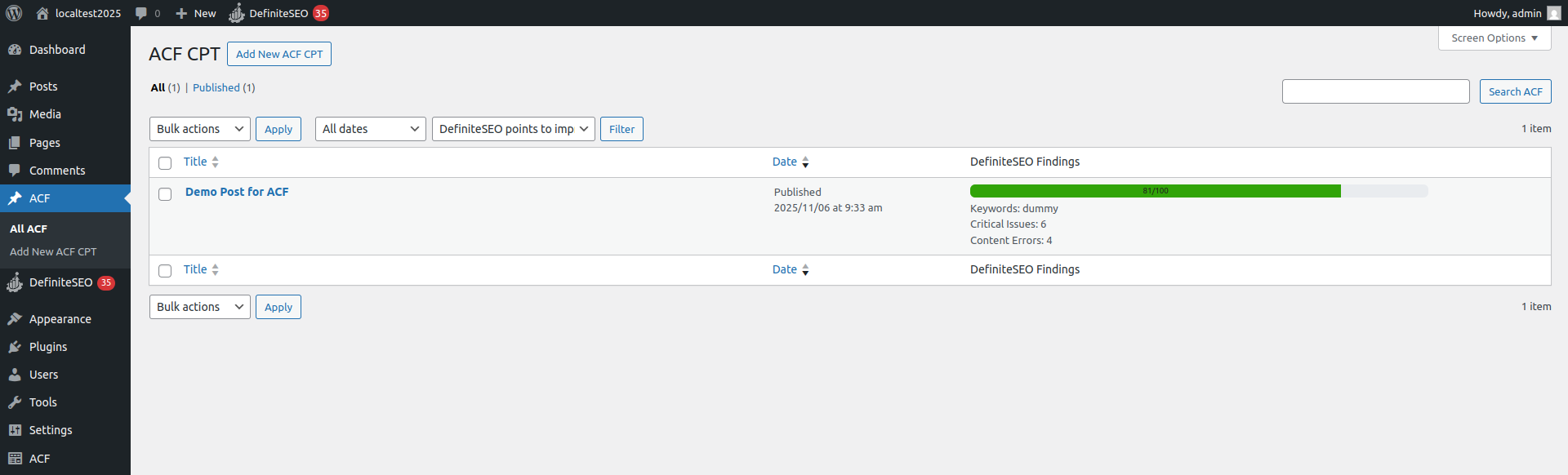
DefiniteSEO’s compatibility with ACF changes that dynamic entirely. It bridges the technical divide between flexible content architecture and intelligent search optimization. Instead of treating ACF-based content as invisible or secondary, DefiniteSEO recognizes it as a first-class SEO citizen, complete with meta data, schema markup, and AI-ready contextual awareness.
In a landscape where search engines are transitioning from keyword indexing to entity and context-based interpretation, this level of compatibility is not a luxury, it’s essential.
DefiniteSEO doesn’t just extend SEO to ACF content; it transforms how WordPress communicates meaning to both Google and AI-driven engines like ChatGPT, Perplexity, and Gemini.
The Role of ACF in Building Structured WordPress Content
Advanced Custom Fields redefines how content is organized inside WordPress.
Instead of working within the confines of posts and pages, ACF allows developers and content teams to design complex data structures that match real-world use cases i.e. property listings, team profiles, product data, course directories, and more.
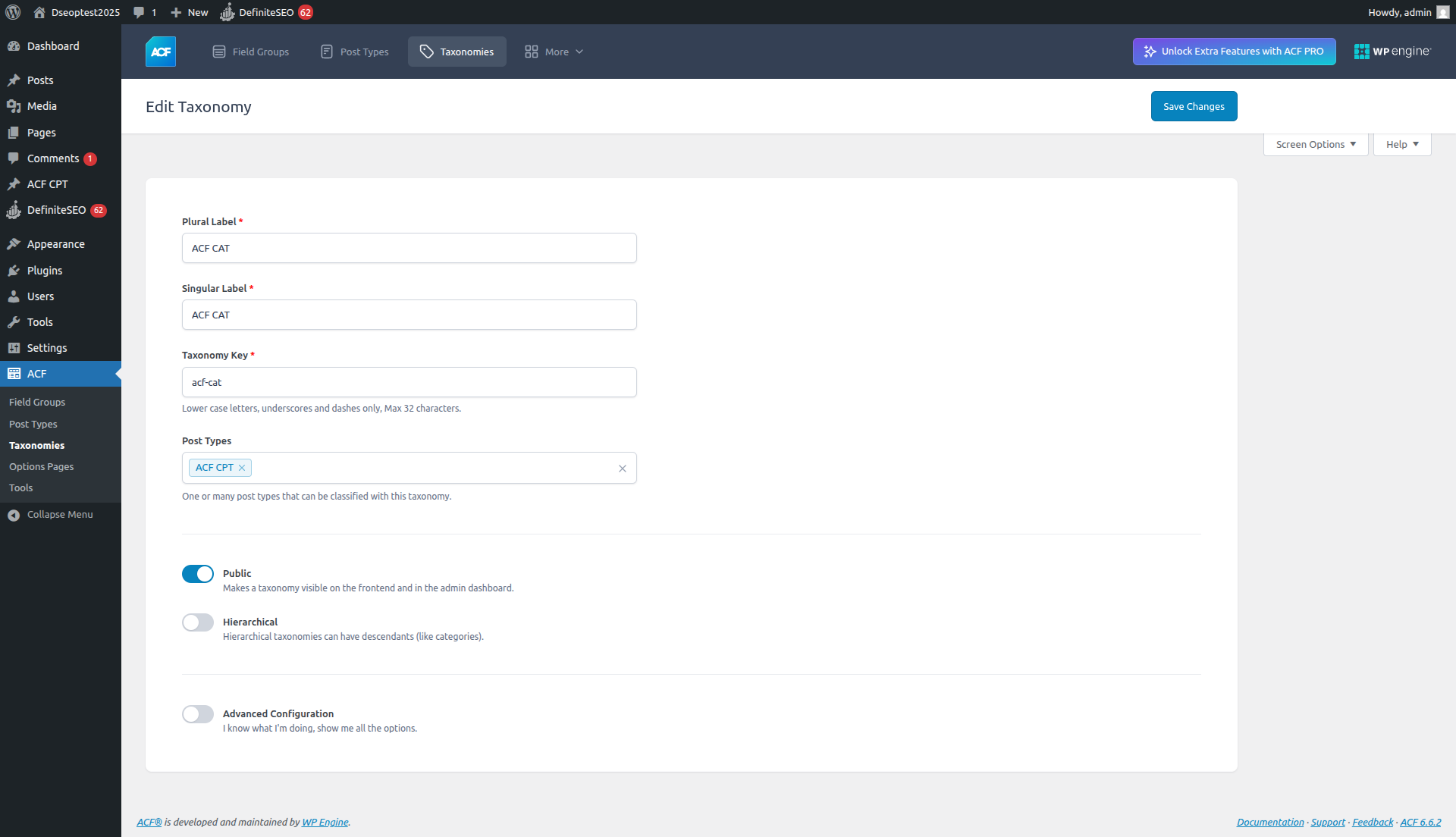
Each field within ACF contributes to structure and clarity. For instance:
- A text field might store a product tagline.
- A relationship field could connect an author’s bio with their published work.
- A repeater field could hold multiple specifications for a single product.
This data structure makes WordPress content far more semantic. Yet for traditional SEO tools, these fields often remain “invisible.” They’re stored in the database, displayed beautifully on the front end, but ignored by SEO analyzers that only scan standard content fields.
That’s where DefiniteSEO steps in, it reads and understands the underlying structure of ACF data, integrating it into every layer of SEO analysis, from meta evaluation to schema construction.
Why SEO Plugins Often Struggle with ACF
Most SEO plugins are designed for predictable WordPress content models: posts, pages, and their associated taxonomies. When developers add new content types or create flexible data models, these plugins fail to connect the dots.
Here’s why:
- Field Separation:
ACF stores data as individual key-value pairs. Each custom field exists independently rather than as a single content body, which makes it invisible to plugins that rely on “post content” for SEO parsing. - Context Ambiguity:
Traditional SEO plugins focus on string-based keyword checks, not context relationships. A field called “Price” or “Location” has meaning only when it’s semantically mapped. - Schema Disconnect:
Without schema-aware processing, these fields can’t be transformed into structured data, the foundation of AI SEO and Answer Engine Optimization (AEO).
DefiniteSEO solves each of these limitations through contextual mapping. Instead of scanning for text alone, it reads structure, hierarchy, and intent. Every ACF field becomes part of the page’s semantic fabric.
DefiniteSEO’s Native Integration: Bringing Context to Custom Data
When an ACF-based custom post type or taxonomy is registered, DefiniteSEO recognizes it automatically. There’s no manual configuration or additional bridge plugin required.
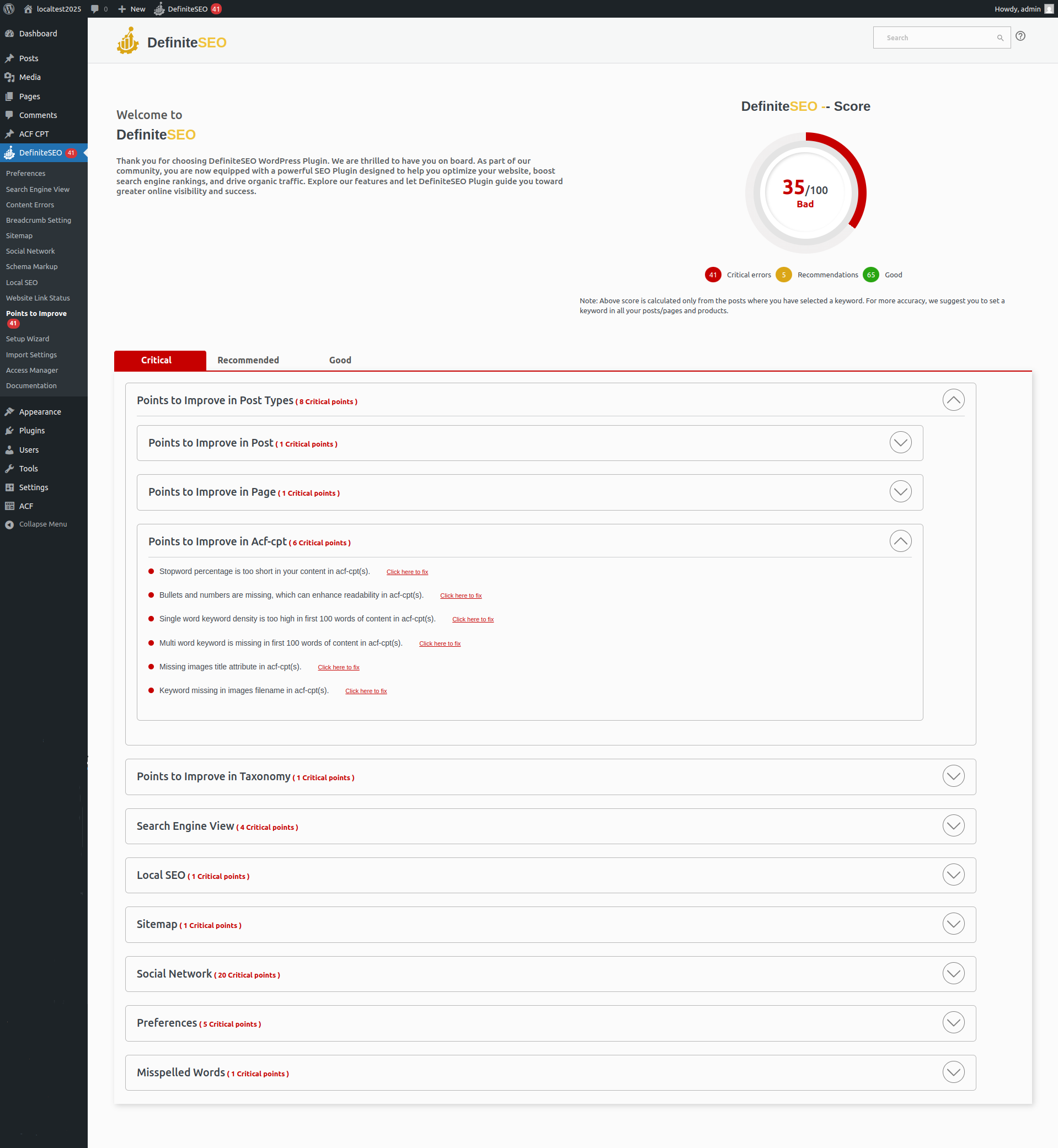
This native integration works at multiple levels:
- Detection: DefiniteSEO identifies all ACF-registered content types and taxonomies and lists them under its “Content Types” settings.
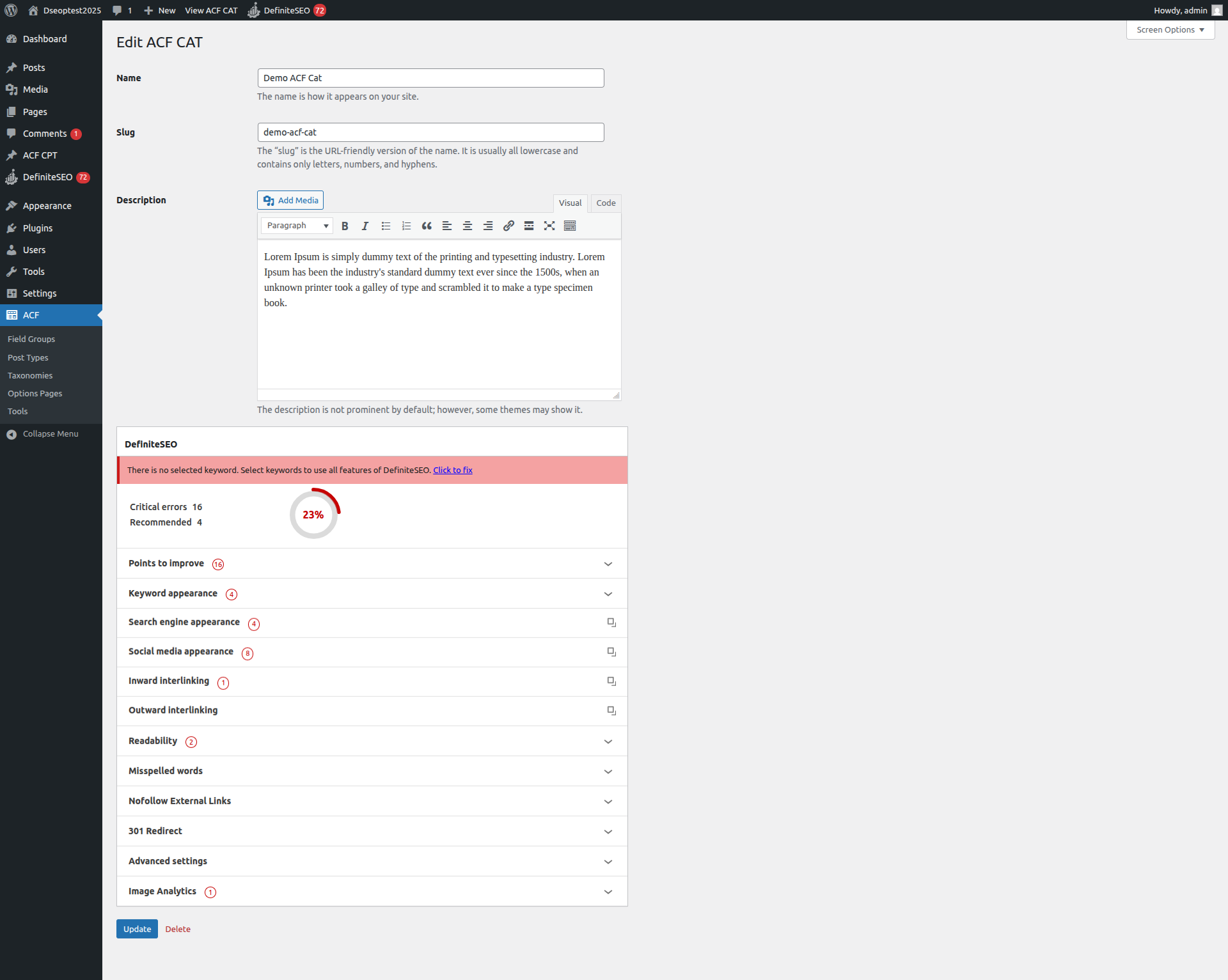
- UI Integration: The plugin injects its optimization panels, including Search Engine, Social Media, Schema, and Local SEO etc. directly into the ACF interface.
- Analysis Inclusion: Content inside ACF fields is parsed during SEO analysis, meaning it directly influences readability scores, keyword density, and optimization metrics.
In practice, this means that whether you’re editing a property listing, a service entry, or a dynamic portfolio item, DefiniteSEO gives you complete control over its SEO presence; titles, meta descriptions, Open Graph tags, Twitter cards, schema markup, and inclusion in XML sitemaps.
This alignment between structure and interpretation is the foundation of AI-ready SEO. When every piece of structured data is both readable and meaningful to engines, your content stands a better chance of being understood, surfaced, and summarized correctly.
Understanding How DefiniteSEO Interprets ACF Fields
DefiniteSEO’s compatibility doesn’t stop at simple field recognition. It’s designed to interpret ACF content the same way a search engine would, by understanding structure and relationships.
When scanning ACF content, DefiniteSEO:
- Reads text, textarea, repeater, and relationship fields.
- Connects data across related posts or terms (e.g., linking an author CPT to a team taxonomy).
- Evaluates field data as part of overall on-page content for both human readability and semantic relevance.
For SEO practitioners, this means no content is left behind. Every custom value you create in ACF; whether a short tagline, specification, or linked entity, becomes part of the content’s semantic graph.
This approach mirrors the shift happening inside AI search systems. Tools like Gemini and ChatGPT now rely on contextual synthesis, where structured inputs define meaning. DefiniteSEO ensures your ACF data contributes to that synthesis.
Technical Compatibility: From Titles to Schema
From a technical perspective, DefiniteSEO extends its full optimization architecture to ACF-based entities. Each registered custom post type or taxonomy gains its own dedicated SEO configuration environment.
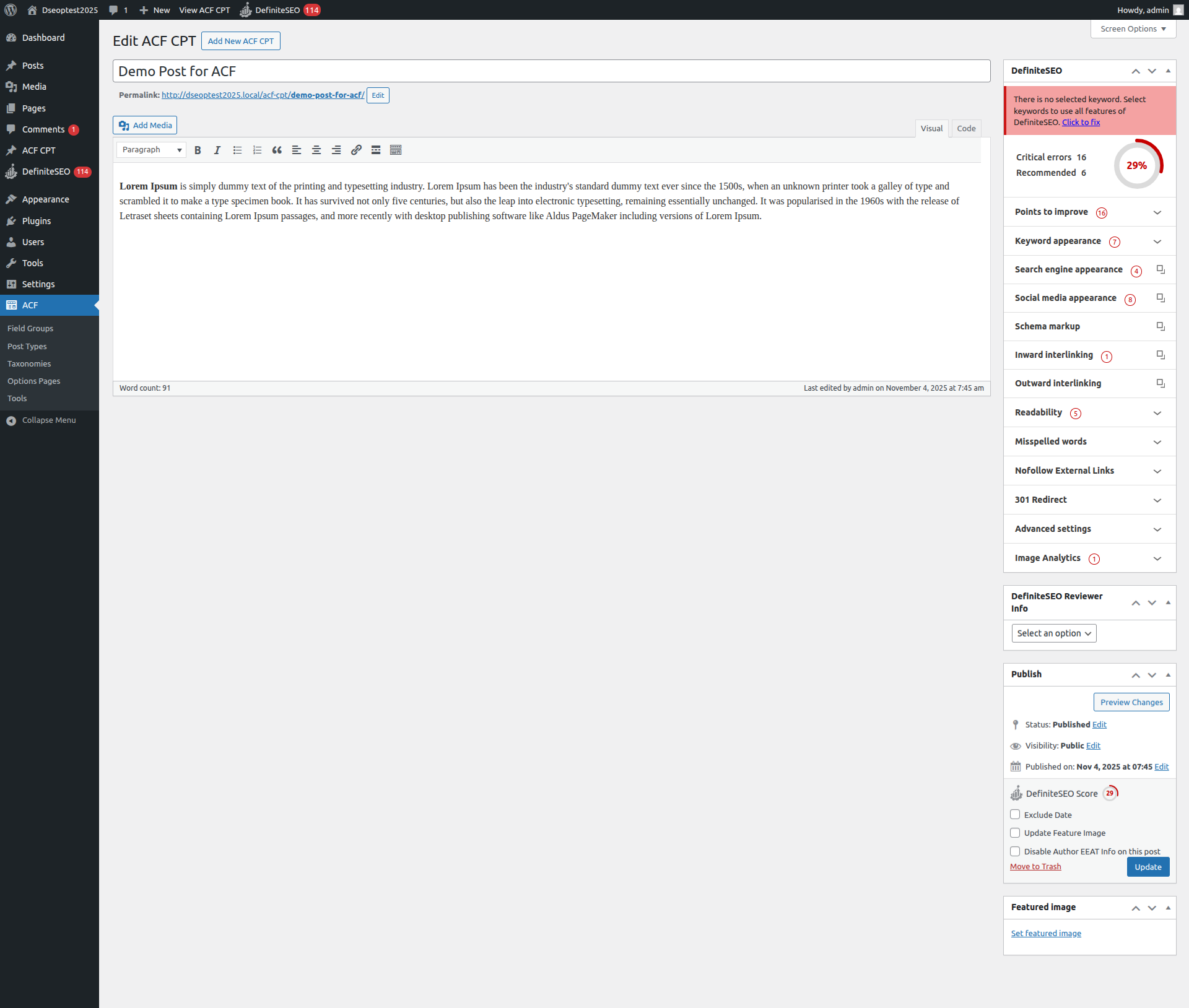
Within these panels, users can:
- Define meta titles and descriptions using dynamic placeholders such as
%title%,%category%, or%site_title%. - Assign Open Graph and Twitter card data for social media platforms.
- Enable schema types relevant to that custom content e.g., “Product,” “Service,” “Organization,” or “Course.”
- Manage inclusion or exclusion from XML sitemaps for better crawl control.
DefiniteSEO’s logic ensures that these configurations apply automatically across all instances of a post type or taxonomy. Developers no longer need to write filters or template overrides; the plugin interprets and outputs SEO-ready data dynamically.
By connecting content fields to metadata and schema output, DefiniteSEO effectively converts raw field values into search-readable entities, a critical foundation for AI Search and Generative Engine Optimization.
Optimizing Custom Post Types Created with ACF
When developers register new post types through Advanced Custom Fields such as Projects, Courses, or Testimonials those structures often live outside the default WordPress SEO scope. DefiniteSEO changes that by treating each ACF-generated post type as a native entity within its optimization framework.
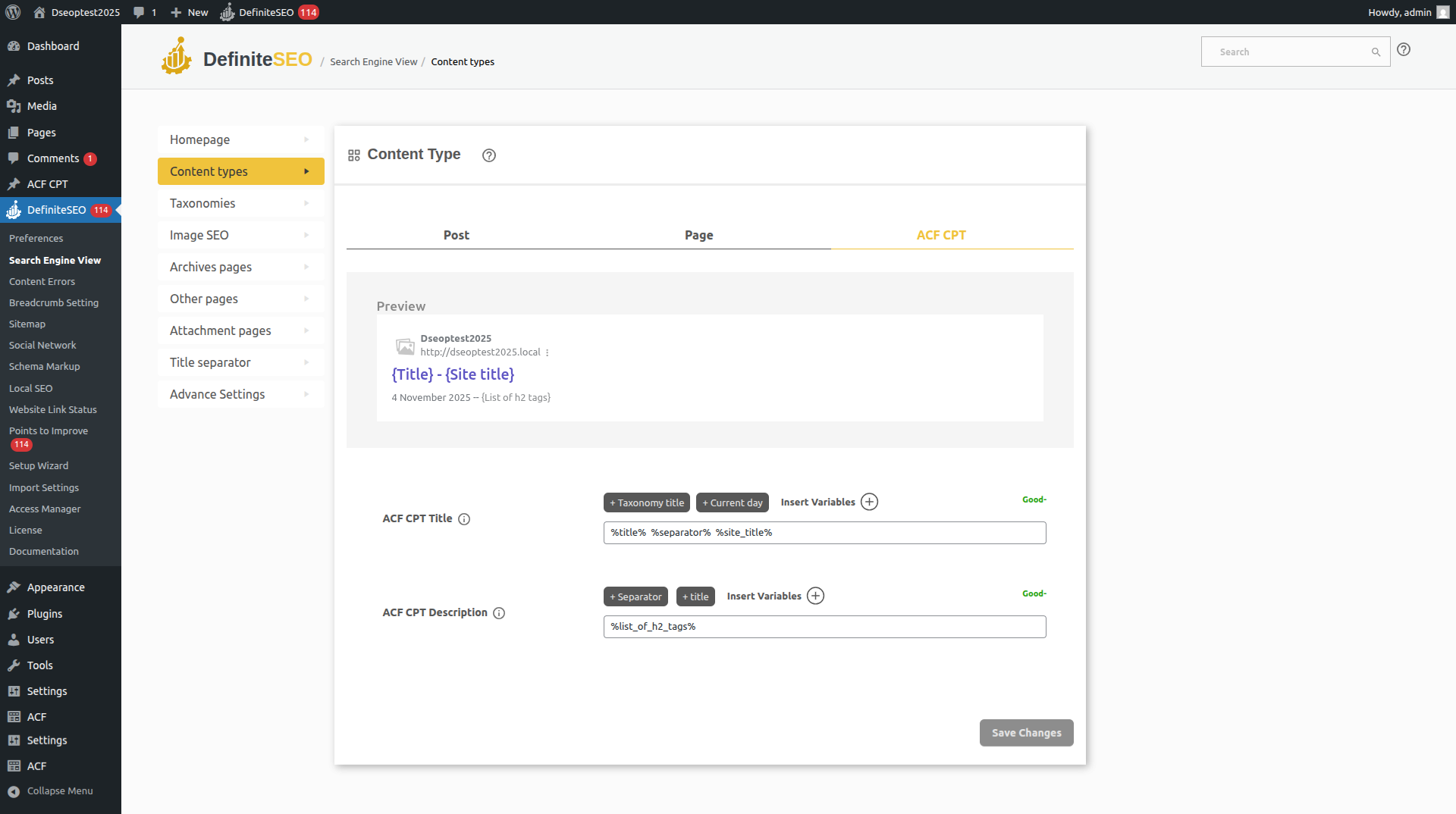
Inside the DefiniteSEO interface, every CPT gains full control panels for:
- Search Engine View, where meta titles, descriptions, and canonical URLs can be customized.
- Points to Improve, which evaluates ACF-based content for missing keywords, poor readability, or absent schema.
- Schema Markup, letting users assign structured data templates dynamically.
- Social Media View, which governs Open Graph and Twitter Card parameters.
Because these settings accept DefiniteSEO’s dynamic variables %title%, %separator%, %site_title%, and more, hundreds of posts can inherit optimized metadata without manual duplication.
Each ACF CPT thereby gains independent SEO authority, yet remains part of a cohesive site-wide hierarchy that search engines can crawl and understand.
Optimizing Custom Taxonomies and Dynamic Archives
ACF often introduces new taxonomies alongside custom post types; categories, filters, or tags that organize data contextually. DefiniteSEO automatically lists these taxonomies under its “Search Engine View → Taxonomies” and “Social Network → Taxonomies” sections.
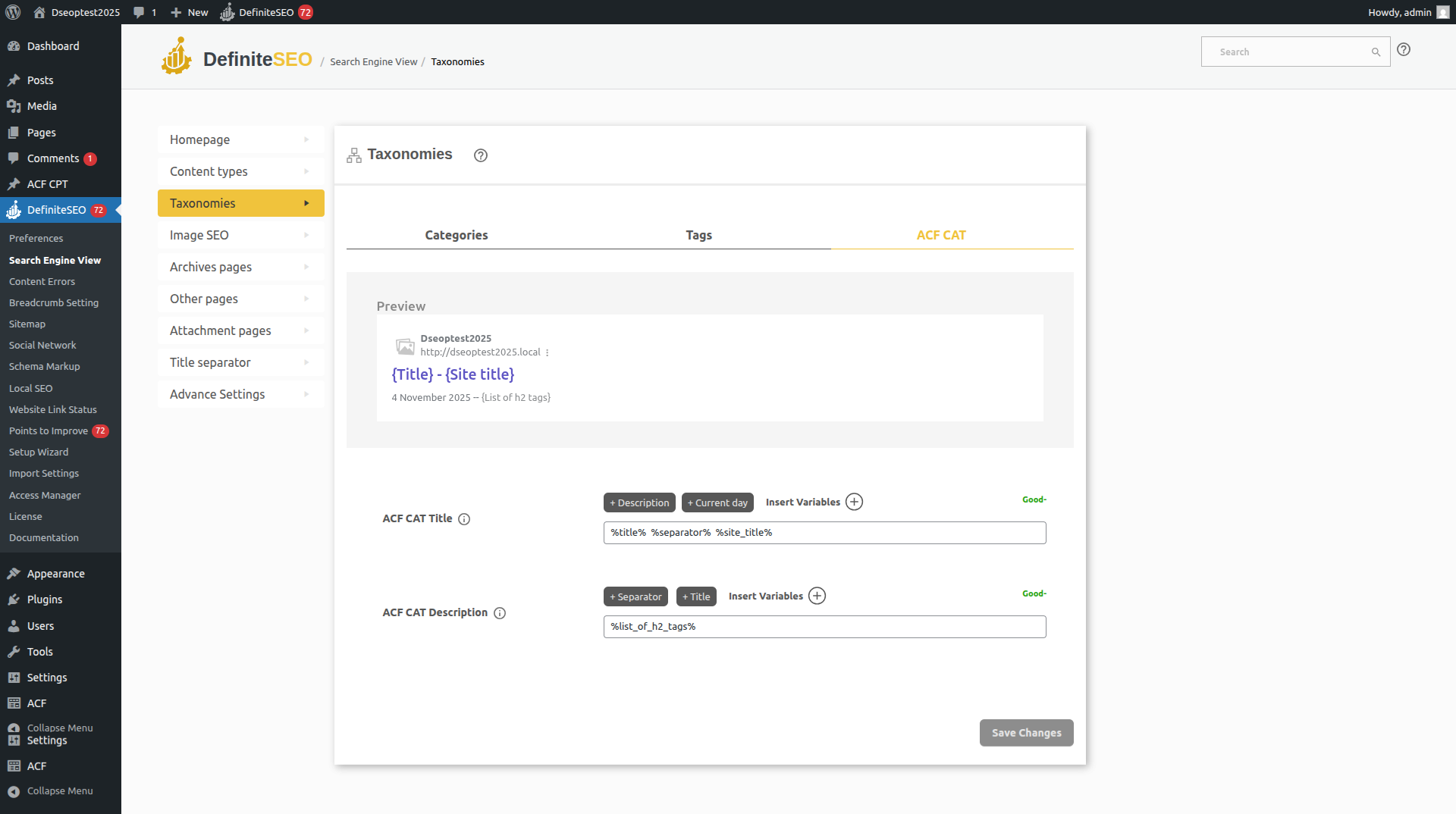
From there, users can:
- Craft archive-level meta titles and descriptions.
- Assign schema types relevant to listing pages.
- Configure canonical URLs to prevent duplicate indexing.
- Add Open Graph images or custom share messages for taxonomy archives.
Because each taxonomy carries distinct topical meaning, properly optimizing these archives helps search engines form stronger entity associations. A category labeled “AI Courses” or “Luxury Properties” no longer acts merely as a filter; it becomes a semantic cluster recognized by both Google’s contextual ranking systems and AI summarization engines.
Open Graph, Twitter Cards, and Social Metadata for ACF Entities
Social visibility contributes directly to brand trust and click-through rate. DefiniteSEO extends its Social Metadata Framework into every ACF-registered entity so that structured content shares consistently across networks.
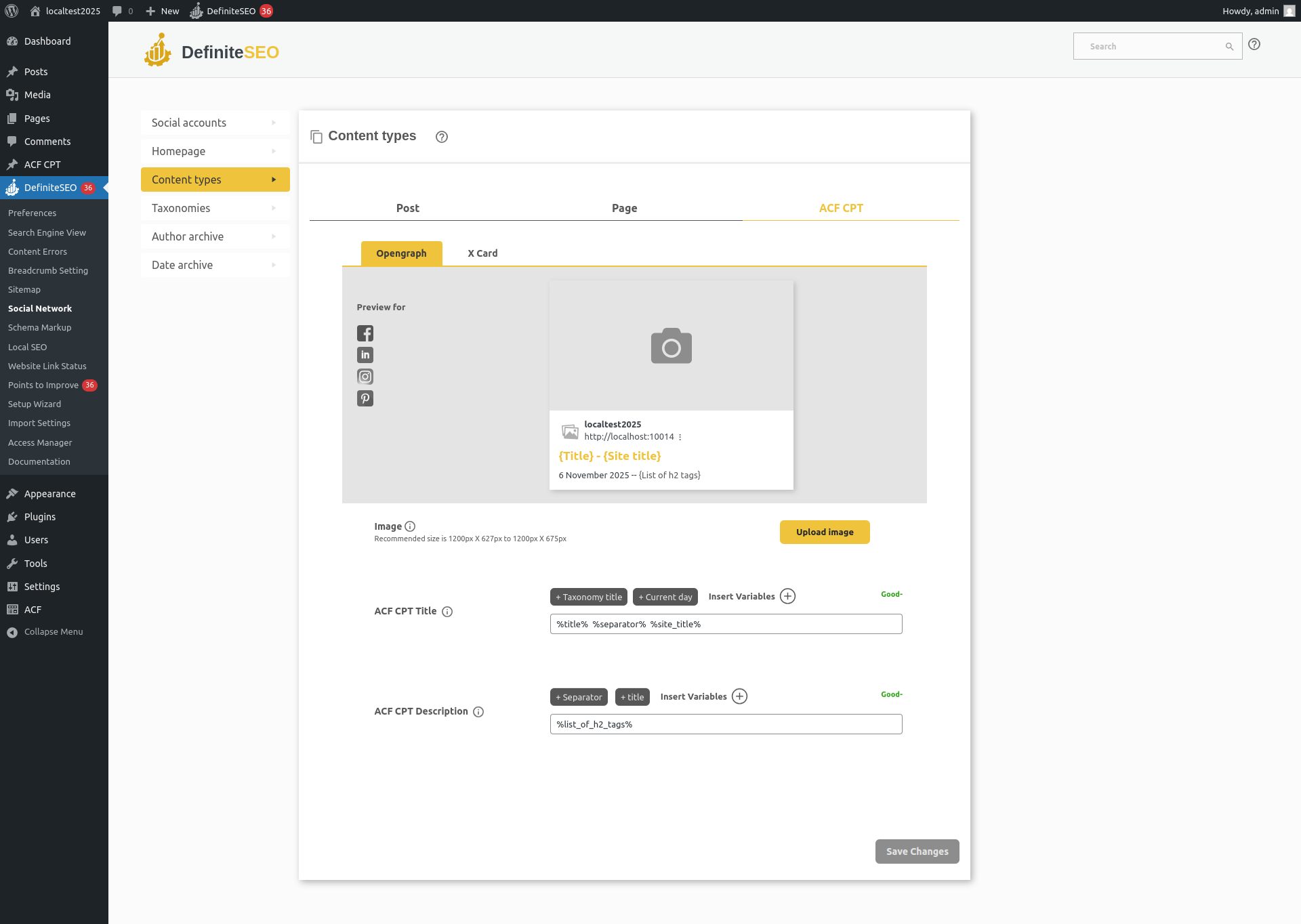
Within the plugin’s Social Network settings, editors can define:
- Open Graph titles and descriptions.
- OG images specific to post types or taxonomies.
- Twitter card text and image previews.
These fields accept both static text and dynamic placeholders, ensuring flexibility for developers who prefer automated output.
When shared, ACF-driven URLs display complete, branded snippets rather than generic excerpts; an essential step for reputation management and Answer Engine Optimization (AEO), where social signals contribute to perceived authority.
Sitemap Management for ACF Content
A structured sitemap ensures discoverability. DefiniteSEO integrates ACF content directly into its XML Sitemap Generator, creating separate sitemap indexes for each CPT and taxonomy.
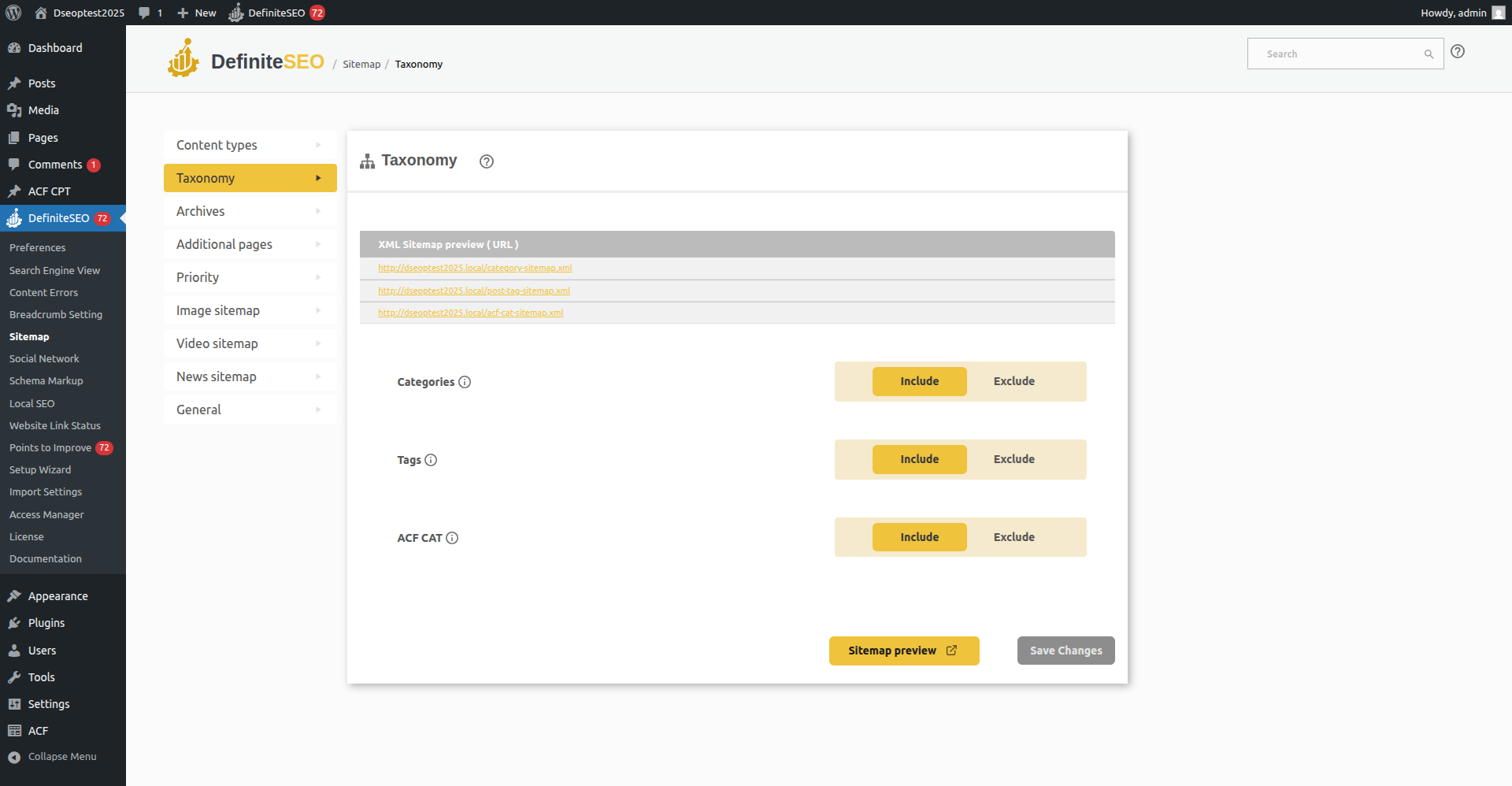
Key advantages include:
- Fine-grained inclusion/exclusion toggles for every ACF entity.
- Automatic URL regeneration when new posts or terms are published.
- Lightweight query execution that prevents load spikes on large datasets.
By submitting these XML sitemaps to Google Search Console or Bing Webmaster Tools, webmasters guarantee that custom entities receive equal indexing priority.
This mechanism also helps AI crawlers, which increasingly reference sitemap data for contextual ingestion, understand how structured content interrelates.
Schema Automation and AI SEO Readiness
Schema markup has evolved from a ranking aid into a communication layer between content and algorithms. For ACF users, schema integration historically required custom code. DefiniteSEO replaces that manual effort with intelligent automation.
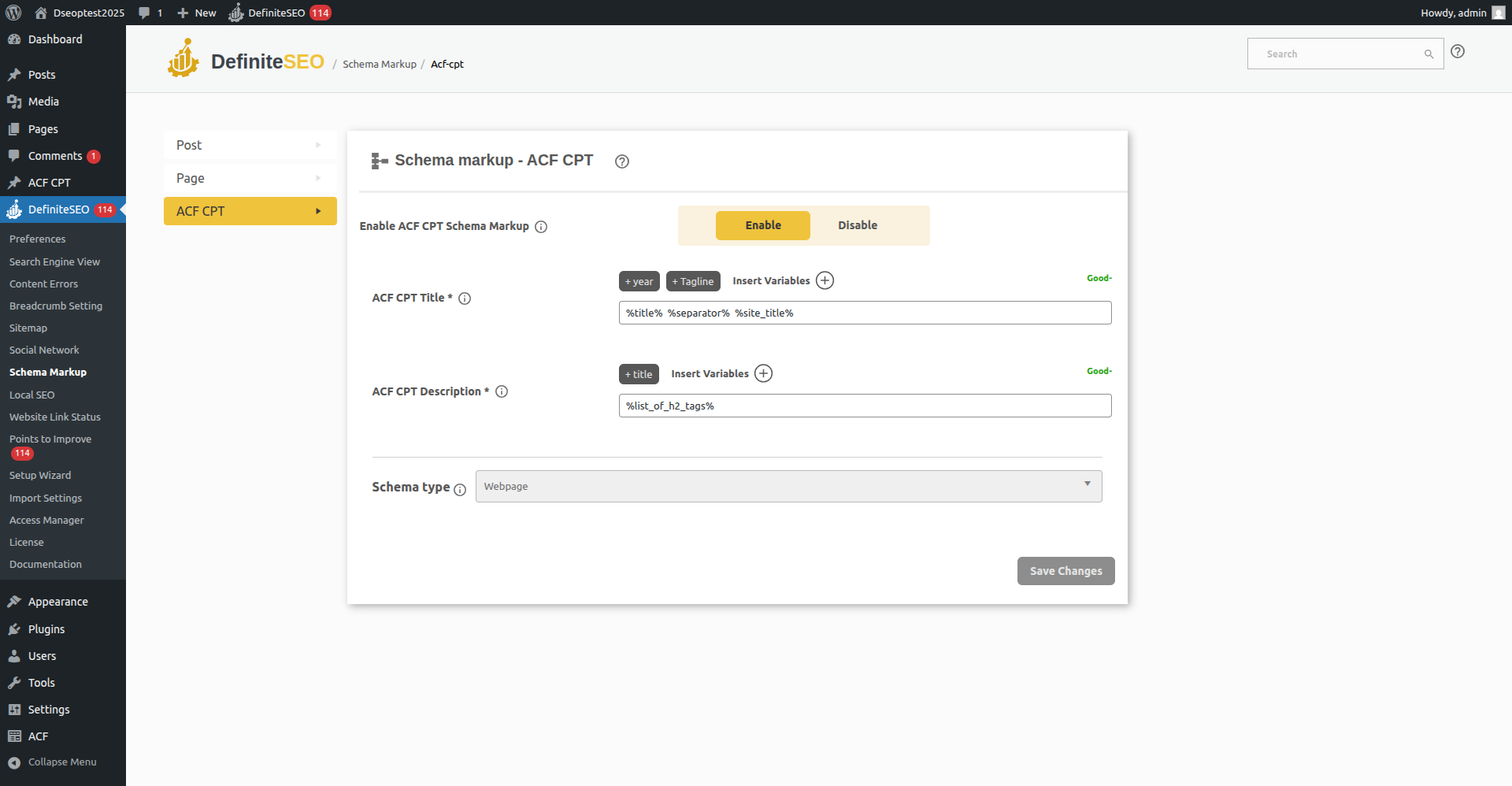
Within the Schema panel of each ACF custom post or custom taxonomy, users can:
- Select predefined schema types like Article, Course, Service, or Product.
- Map schema fields to ACF values dynamically.
- Extend markup with Local Business, Review, or Organization attributes when relevant.
DefiniteSEO’s schema engine translates these configurations into JSON-LD automatically.
This structured data not only supports traditional rich results but also enhances AI comprehension, feeding Generative Engine Optimization (GEO) processes that rely on explicit relationships between entities.
As AI search systems generate direct answers rather than ten-blue-link results, sites with clear, schema-driven meaning stand a higher chance of being cited as authoritative sources.
AI SEO Perspective: Turning Structured Data into Search Context
AI search models operate on context graphs rather than string indexes. They evaluate how pieces of information connect, which entities interact, which values describe them, and what relationships exist among them.
By interpreting ACF fields as structured nodes rather than isolated text, DefiniteSEO helps build that context. Each custom field becomes a semantic signal that modern engines can read:
- A “Course Duration” field reinforces an educational entity.
- A “Property Location” field anchors a geographic relationship for local intent.
- A “Speaker Profile” field links identity to expertise for author trust.
These micro-relationships feed directly into how large-language models summarize and attribute information.
In effect, DefiniteSEO + ACF turns every custom field into a line of communication with AI systems, ensuring that what you build in WordPress can be meaningfully represented in generative search results.
Best Practices and Performance Harmony
Integration often raises performance concerns, but DefiniteSEO’s compatibility layer is built natively within WordPress standards. It uses conditional loading and metadata caching to maintain efficiency.
Recommended best practices:
- Consistent Field Naming — Avoid ambiguous labels like “data1” or “field2.” Clear names improve both readability and schema mapping.
- Template Hygiene — Ensure that ACF values output in semantic HTML elements (headings, lists, paragraphs).
- Balanced Indexing — Exclude utility CPTs or internal taxonomies from sitemaps to reduce crawl noise.
- Periodic Re-analysis — Run DefiniteSEO’s content analysis after ACF structural changes to refresh optimization metrics.
Following these principles keeps your site fast, interpretable, and algorithm-ready, essential for both human UX and AI ranking signals.
Future of Structured SEO in the Age of AI
As AI search systems mature, the distance between structured data and natural language understanding continues to shrink.
DefiniteSEO’s roadmap anticipates this evolution by focusing on entity-first optimization and semantic automation.
Upcoming enhancements will introduce:
- Field-level entity tagging, allowing users to declare what each ACF value represents.
- AI Insights, which analyze how generative engines might summarize a page.
- Predictive Schema, recommending markup based on detected content intent.
These initiatives align with DefiniteSEO’s broader mission, guiding WordPress users from traditional SEO toward AI-optimized discoverability, where clarity, structure, and context determine authority more than backlinks or keyword repetition ever did.
FAQs
Q1. Does DefiniteSEO support both ACF Free and ACF Pro?
Yes. The integration detects field groups from both versions automatically, applying identical SEO and schema capabilities.
Q2. Which ACF field types are included in SEO analysis?
Text, textarea, repeater, and relationship fields are natively parsed. These feed into readability scoring, keyword distribution, and schema mapping.
Q3. Can I apply different schema types to various ACF post types?
Absolutely. Each CPT can carry its own schema definition and variable mapping for maximum relevance.
Q4. Do ACF taxonomies appear in XML sitemaps automatically?
They do. Every taxonomy registered through ACF is indexed by default, with manual toggle options available under Sitemap Settings.
Q5. How does DefiniteSEO ensure performance with large ACF datasets?
It loads field data on demand and uses internal caching to avoid query overhead, keeping page speed metrics stable even on data-heavy sites.